
Earthquakes, Evolution, and Darwin’s Exploits in Chile
Though earthquakes are certainly destructive, the geological process behind such fearsome events has provided favorable conditions for life on Earth, and particularly human life. Plate tectonics — which takes after the Greek word “tekton,” meaning builder — sustained life by grabbing rocks into the bowels of the Earth and then spewing them back upwards, thereby delivering nutrients to the surface and fulfilling an important role during early stages of the planet, prior to the emergence of photosynthesis. Even though quakes located along plate boundaries can devastate human society, there is no doubt constant recycling of the planetary crust has yielded a thriving and habitable planet.
Billions of years ago, crustal recycling produced the oceans and atmosphere, while helping to form continents. To this day, such recycling is indispensable since it builds mountains, enriches the soil, regulates temperature and ensures a healthy chemical balance within the ocean. As mountains rise, this encourages the spread of biodiversity, particularly among mammals and rodents: that is to say, “geological processes play a direct role in the shaping of life on Earth.” What is more, tsunamis linked to earthquakes may help distribute sediments from rivers along coastal plains, thus making soil richer. Tectonic activity may also reshape marine environments, allowing restricted species to colonize new ranges.
However, while earthquakes have certainly helped make Earth habitable over the long-term, that doesn’t mean they haven’t resulted in dire environmental consequences in the short-term. Indeed, forests may find it difficult to recover from earthquakes, since the latter split and uproot trees while disturbing water and nutrient supply. Moreover, quakes may negatively affect plant diversity within fragile alpine grassland areas. In addition, quakes can give rise to landslides, which in turn may bury whole bird colonies and breeding spots. Furthermore, quakes can have detrimental impacts upon aquifers, while flushing out groundwater fauna and small crustaceans.
What about our own human evolution? When Homo sapiens descended from trees, they explored tectonically active areas, and some researchers believe we benefited from such disrupted landscapes. Indeed, while early hunters may have been at a disadvantage on the level savannah, they could have exploited more irregular terrain to hunt animals. Additionally, tectonically active areas are more likely to contain sources of water, since earthquakes may trap such water behind rocky barriers, thereby giving rise to lakes.
Later, however, quakes might have contributed to societal collapse of Bronze Age civilizations after an “earthquake storm” hit the Aegean and Eastern Mediterranean around 1,200 B.C. Because cultures at the time were inextricably linked, they could have been vulnerable to cascading crises, hence falling like a literal and proverbial house of cards. On the other hand, the demise of Mycenae and the Hittite Empire may not have been regarded as a tragedy by those who had been oppressed by elite and hierarchically organized societies.
In the more recent past, earthquakes have shaped politics and society. Take, for example, the Lisbon quake of 1755, which, in tandem with fires and a tsunami, almost destroyed the city while killing between thirty and forty thousand people. However horrific, the quake had wide-ranging effects on European culture. The catastrophe struck on a religious holiday, and in the wake of the disaster, theologians speculated the quake must have reflected divine judgment. If anything, however, the catastrophe accelerated anti-church sentiment while turbo-charging the Enlightenment, with some claiming the quake may have represented the birth of the modern age. In Candide, writer-philosopher Voltaire skewered the church, criticizing the idea of a benevolent deity amidst “the best of all possible worlds.” The quake also gave rise to an unprecedented international relief effort, and the birth of seismology as a genuine scientific pursuit.
It was within this earlier context that Charles Darwin sought to understand quakes. Traveling aboard HMS Beagle in 1835, the young scientist observed the destructive aftermath of an earthquake which, in a mere six seconds, leveled much of the Chilean town of Concepción. It was “the most awful yet interesting spectacle I ever beheld,” Darwin remarked. The city, he added, amounted to a veritable “pile of ruins,” with “nothing more than…lines of bricks, tiles & timbers … there is not one house left habitable.” The earthquake in turn gave rise to a tsunami which resulted in destruction of the neighboring town of Talcahuano. At least fifty people died from the combined effects of the earthquake and tsunami.
While certainly destructive, the 1835 quake influenced Darwin’s thinking and hence shaped more recent conceptions of geology. Following the disaster, the scientist hunted for fossils in the bay of Concepción and noted that rocks covered in recent marine shells were located above the tide, suggesting uplift. Subsequently, while traveling inland, Darwin discovered yet more marine shells in mountainous terrain, thus demonstrating that shifts had uplifted the coast. Darwin came to believe the Earth’s crust was comprised of huge sheets of rock – a concept reminiscent of tectonic plates – that rose and fell in line with molten material beneath which would alternatively heat up, cool down, expand or collapse.
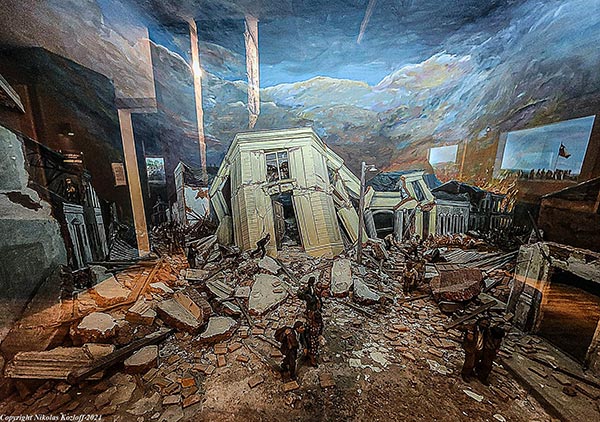
Though Darwin’s observation of the 1835 quake proved harrowing, the event was followed by other disastrous quakes. Indeed, Chile itself lies on the Pacific Ring of Fire where the Nazca plate gets subducted below the South American plate. While traveling in Chile last year, I paid a visit to the local Gallery of the History of Concepción. One exhibit featured a model depicting devastation associated with the Chillán earthquake of 1939, measuring 8.3 on the Richter scale. The catastrophe destroyed 95 percent of Concepción’s houses and caused around 28,000 deaths, the highest number of casualties of any earthquake experienced in Chile.
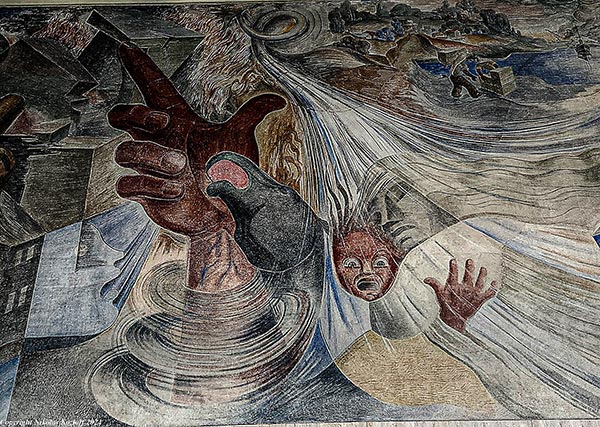
Later, while walking near the coastline, I came across a bleak slab of stone memorializing yet another quake which occurred in 2010. This seismic event measured 8.8 on the Richter scale, damaged hundreds of thousands of homes, killed more than 500 and caused a tsunami. A gripping mural by artist Gregorio de la Fuente, located near the memorial site, depicted ongoing natural disasters which have afflicted Concepción.

Hoping to gain further insight into the impact of such quakes, I headed to the Department of Geophysics at the University of Concepción, where I spoke with academic experts, including professors Arturo Belmonte and Ignacia Calisto, as well as Matías Fernández, a graduate student. Chile lies within a prime tectonic zone, Belmonte said, and will continue to be geologically active for quite some time. Indeed, the area has witnessed many cataclysmic events: going back to around 10,000 B.C., indigenous peoples managed to adapt to the extreme environment, including earthquakes and tsunamis. Almost four thousand years ago, a major “tsunamigenic earthquake” seems to have disrupted pre-historic hunter-gatherer-fisher communities, thereby forcing people to embrace “resilient strategies” along the coast.
What of more recent times? While estimates may vary, Fernández believed Concepción had been hit with somewhere between an 8.2 and 8.7 quake in 1835, based on modeling and contemporaneous accounts. As he processed his “mingled” impressions, Darwin remarked the quake had aroused a a strange sense of insecurity within him. Though the naturalist hardly minimized the actual horror of the event, he added that “in my opinion, we have scarcely beheld, since leaving England, any sight so deeply interesting.”
The quake also exerted curious effects on the local population. On the one hand, people reacted with “the greatest alarm,” and “no one knew whether his dearest friends and relations were not perishing from the want of help.” Survivors were obliged to keep a watchful eye due to thieves, while others “filched what they could from the ruins.” On the other hand, amid the aftermath of the tsunami, “happy” children made boats with tables and chairs.
Meanwhile, the catastrophe brought people together and residents “seemed more active and happier than it would have been expected after such a terrible catastrophe.” The quake had become, quite literally, a “social leveler”: “it has been noted,” Darwin wrote, “with some truth, that being general destruction, no one felt more humble than his neighbor, no one could accuse his friends of coldness, two causes which always added a sharp pain to the loss of wealth.”
Speaking to experts, I got the impression that more recent quakes had also brought out the best and worst amongst people. Growing up, Belmonte said that earthquakes weren’t a prominent topic of discussion. As an adolescent, however, he experienced a quake in 1985 while living in Santiago. The disaster measured 8.0 on the Richter scale and caused at least 177 deaths. Following the quake, hundreds of residents camped out in garbage-strewn streets, afraid to go back to their homes.
Nothing could prepare Belmonte, however, for the 2010 quake which was much more serious. Six months prior to the catastrophe, the scientist had moved to Concepción after landing his academic job. At 3:30 in the morning on February 27th, he found himself up late, ironically enough watching the movie Titanic. “I’m not joking,” he quips animatedly, “I was just at the scene where the ship breaks apart.” Sensing movement, he thought at first it was nothing more than a passing train.
He quickly changed his tune, however. “I never felt like that before in my life,” he explained, adding that for a few moments he was confused and wondered if he himself was in the midst of a fictionalized movie. Grabbing his two-year-old daughter, Belmonte hit his face on the floor of the stairs and feared the entire house would collapse. Outside, he heard a neighbor cry out, “tsunami!” Scared for his life, the scientist jumped in his car while his wife observed serpentine-like incoming waves. Fortunately, the family evacuated to safety, but Belmonte was isolated for several days amidst absolute destruction resembling a warzone in Concepción.
The quake, which was stronger than what Darwin had experienced, measured a whopping 8.8 on the Richter scale and literally moved Concepción ten feet to the west. It is thought the disaster could have even shortened the length of the day by more than a microsecond and moved the Earth’s figure axis by 8 centimeters. What is more, the disaster gave rise to novel environmental changes. Indeed, the thirty-foot-high tsunami and earthquake affected wildlife and vegetation along the coast in distinct ways.
Grass beds along the ocean floor, for instance, were buried in sand or uprooted. This in turn resulted in economic hardship for sea grass harvesters, who were obliged to turn towards other sources of income such as timber harvesting. Meanwhile, in some areas lacking seawalls where beaches had sunk, inter-tidal animal populations plummeted even as entire habitats became submerged. In other areas where beaches were uplifted, however, inter-tidal species quickly moved into new stretches of coastline which had risen in front of sea walls. Surprised scientists observed that plants had returned to places which had been devoid of such vegetation for some time.
As in Darwin’s day, the catastrophe gave rise to a host of social changes. The quake killed 500 people and injured 12,000 more, while damaging or destroying hundreds of thousands of homes. The casualties were gruesome, with many dead found under buildings and inside cars. In some locations, a blackout went on for several days as curfews were imposed. In Concepción, meanwhile, fires broke out, a prison riot erupted, and extensive looting of supermarkets occurred.
Belmonte believed the supermarkets might have freely distributed essentials such as food and milk, “but people walked out with televisions and washing machines. Unfortunately, that’s how it was.” In the nearby fishing town of Talcahuano, which had been left to fend for itself, residents formed vigilante groups with acquiescence of the local police. Though Belmonte was moved by untold human suffering, he too could not help feeling intrigued as a scientist. In the aftermath, there was a flurry of interest in plate tectonics and “we started talking about earthquakes like never before in Chile.”
Moreover, the scientist believed such disasters could ultimately unite people in common struggle amid adversity. In the aftermath, he pooled resources with neighbors and a sense of solidarity emerged. Calisto, Belmonte’s colleague, added “even people who thought they were enemies, more or less, realize that under these certain circumstances they actually become friends.”
I’m riding north from Concepción to Santiago, reflecting on Darwin’s legacy. Some believe the naturalist’s observation of the quake at Concepción — as well as other geological phenomena in Chile — have been colossally ignored, and together exerted a much bigger impact on the scientist and his evolutionary thinking than has commonly been acknowledged. On the other hand, though Darwin certainly recognized the impact which geological change exerted on the Earth, the naturalist might have been surprised to find that currently, the reverse would also seem to be true: that is to say, Homo sapiens themselves may be exerting an impact on tectonics.
Researchers have grown concerned about the “environmental hazard” of geo-engineered activities. Indeed, the latter can lead to “geo-mechanical pollution” which in turn can accelerate the timeclock of quakes. Such “human-triggered” earthquakes may destabilize shallow faults in the upper region of the Earth’s crust. Geo-engineering projects, including mining, artificial water reservoirs, hydrocarbon production, wastewater injections and formation of artificial land have triggered earthquakes. However well intentioned, injecting carbon dioxide underground to reduce greenhouse gas emissions, as well as pursuing geothermal energy production, can similarly trigger quakes.
Climate change itself seems to be having an impact on geological activity, which might have intrigued Darwin. While in Tierra del Fuego, the scientist speculated about the knock-on effect which earthquakes might have on sea and land. “Great masses of ice,” he wrote, “frequently fall from… icy cliffs, and the crash reverberates like the broadside of a man-of-war through the lonely channels. These falls… produce great waves which break on the adjoining coasts. It is known that earthquakes frequently cause masses of earth to fall from sea-cliffs: how terrific, then, would be the effect of a severe shock… on a body like a glacier, already in motion, and traversed by fissures!”
Echoing Darwin, scientists believe thawing of glacial ice has caused portions of the Earth’s crust to rebound upwards at different times. For example, thawing occurred towards the end of the last ice age about 10,000 years ago, causing the Earth’s crust to rise. In Scandinavia between 11,000 and 7,000 years ago, uplift gave rise to an earthquake “storm,” with one quake linked to a huge submarine landslide off the Norwegian coast, which in turn spurred a tsunami in the North Atlantic accompanied by gigantic sixty five-foot tall waves. Now, however, rising rates of glacial melting could exacerbate quakes. As ice sheets melt, reduced load on the crust below causes faults to release pent up strain. This is cause for concern in places like Greenland, which is losing vast quantities of ice. Underneath the surface, the crust is uplifting and consequently raising the specter of quakes which could trigger submarine landslides and tsunamis.
Rising rates of rainfall could also have an impact on quakes. During monsoon season in South Asia, the weight from rainfall compresses and stabilizes the Earth’s crust. However, when water gets depleted in winter, this “rebound” destabilizes the area and leads to more earthquakes. In an age of accelerated climate change, this phenomenon could become more intense. Already, average rainfall across the world has increased, since a warmer atmosphere retains more water vapor. Modeling predicts climate will similarly increase monsoon intensity, which could in turn cause the winter rebound to trigger more seismic activity.
At the end of my trip, I paid a visit to the Geological Museum in Santiago, where I was impressed with samples of ancient ammonite fossils, the likes of which Darwin came across during his travels. While in Chile, the naturalist was also struck by deplorable conditions facing miners, and I wanted to get a sense of how the mining industry had changed over time, as well as risks from seismic activity.
In an adjacent office, I spoke with Hans Kauffmann, a geo-chemist heading up government laboratories at the National Service of Geology and Mining (also known by the Spanish acronym SERNAGEOMIN). Darwin observed the mining industry in its infancy, the expert noted, when there were no safety equipment or precautions. Today, he added, conditions have improved immeasurably, both for miners themselves as well as the environment. Kauffmann conceded, however, that quakes always pose a risk to mining operations.
But what of the reverse? A few months ago, six workers perished at Chile’s El Teniente, one of the world’s largest copper mines, after a 4.2 magnitude tremor resulted in collapse. Reportedly, the tragedy “is likely to have been caused by mining activity” and “stresses resulting from the project’s own extractive processes” rather than any natural shifting of tectonic plates. The Chilean mining industry, whose projects must be designed to withstand such seismic activity, was taken aback by the “self-induced” disaster, and some wondered whether it was safe to resume operations.
Plate tectonics has shaped evolution by both stirring and destroying life at different times, yet now, it seems, human activity itself may be accelerating subterranean forces deep within the ground, a trend which Darwin may not have foreseen.
(This article is human-based and not assisted by the use of AI)
Leave a comment