
Volcanoes, Climate Change and Darwin’s Legacy in Chile
Throughout earth’s evolution, volcanoes have contributed to the rise of complex life, yet now could eruptions be overlapping with cascading natural disasters? It’s a question which might have intrigued Charles Darwin, who visited Chile at various points between 1832-1835 during his epic voyage of discovery aboard HMS Beagle. Though the naturalist focused on wildlife when formulating his theory of evolution, Darwin was also struck by the rugged landscape in Chile, and encountered widespread evidence of geological uplift over almost endless time, which allowed for natural selection to occur.
Last year, I retraced the naturalist’s exploits in Chile in the context of growing climate change. In Santiago, I visited the Geological Museum and sat down with Hans Kauffmann, a geo-chemist heading up government laboratories at the National Service of Geology and Mining (also known by the Spanish acronym SERNAGEOMIN). From the moment Darwin set foot in Chile, Kauffman remarked, the naturalist sensed the country was geologically alive. Today, he adds, Chile sports ninety-two volcanoes, of which forty-five are highly active and therefore being monitored.
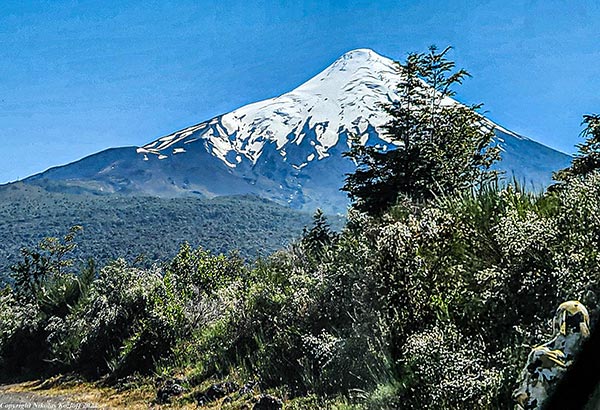
In early 1835, Darwin witnessed the volcanic eruption of Mount Osorno from the island of Chiloé, and a month later, a large section of the Chilean coast was rattled by an 8.5 magnitude earthquake. After observing the dramatic events, Darwin considered the possibility that the entire South American continent was rising from the sea. Later, the naturalist would apply his theory to the globe as a whole, arguing the earth’s crust was comprised of vast sheets of rock — a similar concept to our modern idea of tectonic plates. Such plates rose and fell in accordance with molten material beneath, which could become either heated or cooled while expanding and collapsing.
To this day Osorno is still considered an active volcano, and, as I learned, the surrounding Los Lagos region has witnessed severe eruptions. In 2008, for example, the Chaitén volcano erupted some one hundred miles south of the town of Puerto Montt. The eruption created lahars — violent mudflows flowing down from a volcano — which destroyed much of the nearby town of Chaitén.


Prior to traveling to Santiago, I made my way to Puerto Montt, which I used as a base from which to explore the vicinity. Pedro Sepúlveda, a veteran guide with twenty-four years of experience in the tourist industry, spoke to me about the area’s violent geologic history as we stood beneath the scenic snowy base of Mount Osorno itself. Though my contact did not personally witness the Chaitén eruption, Sepúlveda was taken aback by events sometime later.
On the morning of April 23rd, 2015, my guide was catching up with friends when Calbuco volcano erupted, about 20 miles northeast of Puerto Montt. “We were just socializing,” Sepúlveda recalled vividly, “when suddenly there was an explosion like dynamite.” The sky was completely blue, and for miles around onlookers witnessed plumes of gas and ash. The remarkable spectacle continued for about three days, even lighting up the night sky.
If Darwin was aware of the true importance of volcanoes, he would have been amazed. We don’t know how many active volcanoes might have existed in ancient times, though iron particles in volcanic ash could have served as a catalyst for turning carbon dioxide and hydrogen in the atmosphere into hydrocarbons such as acetaldehyde and formaldehyde. The latter two organic compounds are regarded as vital “building blocks” within fatty acids, DNA nucleobases, sugars and amino acids. Not surprisingly, then, it has been suggested that life itself emerged around volcanoes.
In another twist, perhaps volcanism may have produced lightning which literally catapulted life into existence. In this scenario, magma bubbled up from the Earth’s interior, which was accompanied by electrical energy. When eruptions start underwater, they can give rise to plumes comprised of gases, ash and seawater vapor, a volatile mix which can in turn prompt lightning strikes.
Such volcanic lightning can help form nitrogen compounds found in volcanic rocks. Nitrogen, it should be said, is a vital component of amino acids which are pieced together to form proteins. Without nitrogen, therefore, life’s first forms would not have been able to thrive and evolve. In addition, volcanic activity contributes to the formation of pumice, a porous stone which can float. Rafts of such pumice can transport organic compounds over vast areas of the ocean and thereby might have enhanced the chances of life gaining a foothold in new continents.
Other scientists believe deep-sea volcanoes could have spurred life, thus echoing Darwin’s observations from the Beagle voyage. Take, for example, the Galápagos Islands: measured against the vast scale of geologic time, the archipelago formed relatively recently as the result of volcanic eruptions, prompting the naturalist to speculate the remote location may have provided life with a new direction.
“Seeing every height crowned with its crater,” Darwin wrote, “and the boundaries of most of the lava-streams still distinct, we are led to believe that within a period, geologically recent, the unbroken ocean was here spread out. Hence, both in space and time, we seem to be brought somewhat near to that great fact—that mystery of mysteries—the first appearance of new beings on this earth.”
But the relationship between volcanism, evolution and climate may have gone even “deeper” than Darwin surmised. Kauffmann, the government geo-chemist, noted that volcanic eruptions may exert complex effects on climate. “A volcanic eruption can expel a lot of material and many types of gases,” he said, including carbon dioxide and sulfur dioxide. Before humans started artificially heating up the planet, volcanoes played a significant climate role by spewing out carbon dioxide in the long-term, thereby causing warming. In the short term, however, volcanoes also released sulfur gases which reacted with water, thus giving rise to highly reflective particles called sulfates, which can in turn trigger global cooling.
Prior to the Cambrian, some 600 million years ago, primitive animals inhabited an icy “Snowball Earth.” Then, a vast landmass called Gondwana formed, which was accompanied by volcanic eruptions spewing out carbon dioxide. As temperatures soared during the Cambrian explosion amid global warming, this created the foundation for diverse animal evolution. However, even though volcanic eruptions spurred life, carbon dioxide wound up going into overdrive and acidifying the oceans, which caused mass extinctions during the “Dead Interval.” It would take another 50 million years before animal life flourished again.
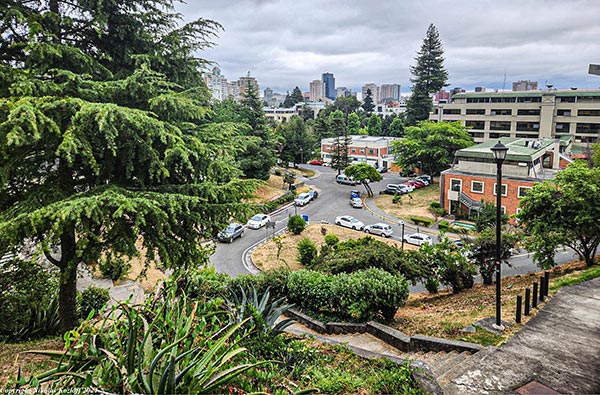
For more, I head to the Chilean city of Concepción. After witnessing the eruption of Mount Osorno in 1835, Darwin spent time here, and the naturalist was astonished by the devastating aftermath of an earthquake. Arturo Belmonte, a professor at the Department of Geophysics at the University of Concepción, told me that “sometimes volcanic eruptions give rise to great catastrophes,” while at other times they may help spur life.
Consider that during volcanic eruptions, sulfur dioxide can react with water droplets, which yields acid rain. This phenomenon played out in real time during the “Great Dying” some 252 million years ago, when nearly all plants and animals were wiped out. Experts believe rapid climate change caused by volcanic activity might have been the culprit, and eruptions could have led to acid rain. Even after eruptions ceased, magma still released carbon dioxide from the earth’s mantle, known as “cryptic carbon.”
In yet another apocalyptic scenario, consider the end-Cretaceous mass extinction, which did away with dinosaurs. Though the extinction was probably caused by the Chicxulub meteor, it’s also possible the impact may have caused an increase in intensity of volcanic activity in India’s Deccan Traps, which released both carbon dioxide and sulfur dioxide. This volcanic activity resulted in drastic climate swings which made life difficult to sustain.
Needless to say, following the demise of the dinosaurs, volcanic eruptions may have continued to exert an impact on our own, Homo sapien development. In 72,000 B.C., the world witnessed the catastrophic Toba super-eruption located in Indonesia, resulting in “an explosion louder than any sound previously heard by humans in their entire evolution.” The event produced a gigantic mushroom cloud reaching into the stratosphere and spewed out sulfur dioxide. The cataclysmic event likely gave way to black skies blocking out sunlight, leading to years of global cooling.
What is more, the eruption may have caused a tsunami, killing anyone so unfortunate to inhabit coastlines. Closer to the eruption site, acid rain probably contaminated the water, while ash could have buried animals and vegetation. It’s not entirely clear what the world-wide impact may have been on Homo sapiens at the time. Though some argue the Toba super-volcano could have killed off the human population, leading to fewer than 10,000 survivors world-wide amidst a “genetic bottleneck,” others claim humans not only managed to survive, but actually adapted. In this scenario, Toba wasn’t a “harbinger of doom,” but rather a “catalyst” for technological innovation.
Though carbon dioxide released by volcanic eruptions during earth’s distant past caused warming, more recent eruptions have not yielded any such detectable global warming and have, more often than not, resulted in the opposite effect. For instance, eruptions are thought to have contributed to the Little Ice Age, lasting from the fifteenth to nineteenth centuries.
For that matter, Indonesia’s Mount Tambora eruption of 1815 spewed masses of dust and sulfur dioxide into the stratosphere. Ten thousand people were killed immediately, and up to one hundred thousand more later perished in the surrounding area due to famine. When ash blocked out sunlight, the cooling which ensued caused crop failures and outbreaks of disease, including typhus. In 1816, the summer was cold, dark and rainy in North America and Eurasia. It has been said that if Tambora had not erupted, Mary Shelley would not have been isolated in her cabin with nothing to do, and hence the novel Frankenstein would not have been written. Perhaps, Tambora even altered world history by creating muddy conditions at the Battle of Waterloo, which could have contributed to Napoleon’s defeat.
In a sense, what better country to visit than Chile when evaluating such cataclysmic history? On campus at the University of Concepción, Belmonte said the Chaitén eruption of 2008 certainly served as a wakeup call, and today the authorities actively monitor all important volcanoes. However, this has created some concern in the Los Lagos area, because whenever an alert is issued, tourists are not allowed into the region. Belmonte added, however, that Chile as a whole is the product of its own “tormented” geography, and ironically, “the entire Los Lagos area is the result of volcanic eruptions.”
Reflecting on Tambora and previous natural disasters, I ask about more recent volcanic eruptions and their likely effect on climate. Matías Fernández, a graduate student and Belmonte’s colleague, cited the case of the 1991 Pinatubo eruption in the Philippines which gave rise to a gigantic plume of gas and ash spreading all over the globe. Pinatubo erupted with such force that 20 million tons of ash and sulfur dioxide were shot fifteen miles high into the stratosphere, a cloudless layer of the atmosphere. The eruption lowered global temperatures by about one degree Fahrenheit in 1992.
The fact that certain eruptions like Pinatubo resulted in surface cooling via stratospheric injection of aerosols (tiny particles in gases) has, over the years, prompted some to suggest that injecting such aerosols into the atmosphere might actually help slow down global warming. Indeed, some vulcanologists have remarked, “with the increasing seriousness of climate impacts on society, the search for ‘geoengineering’ solutions will make it more likely that countries will consider volcano-mimicking interventions — like an injection of aerosols into the stratosphere to cool the Earth’s surface.”
There are many uncertainties about injecting sulfur dioxide into the stratosphere to temporarily block sunlight, which would mimic the effects of the Pinatubo eruption. Unlike CO2 removal, solar geoengineering does not reduce CO2 in the atmosphere but simply masks warming effects. Moreover, no one knows what would happen on a planetary scale if this strategy were pursued. Some studies suggest aerosol geoengineering could alter precipitation patterns, including “crazy” effects on the monsoon.
But perhaps we shouldn’t be asking what types of effects volcanic eruptions or aerosols might have on the climate, but rather the reverse? Indeed, climate change results in the melting of glaciers, many of which cover the edges of active volcanoes. As massive melting occurs, this in turn reduces pressure on the Earth’s surface, even as processes within the crust are altered and hot magma comes into contact with aquifers. Ultimately, this can wind up triggering volcanic activity since “the whole system is interconnected.” Somewhat ominously, volcanoes at high elevation could be impacted by global warming, since the disappearance of ice caps may lead to “instability” and volcanic landslides.
Over the vast arc of geological time, the interplay of glaciers and volcanoes has affected climate: at the peak of the Ice Age tens of thousands of years ago, ice cover suppressed eruptions, thereby allowing magma to build up under the surface. But then, as ice retreated, the crust relaxed and gases contained within magma expanded due to abrupt loss of weight. This buildup in pressure subsequently caused massive volcanic eruptions. These historic patterns suggest we may be in for fluctuations as volcanic eruptions become more “explosive” and frequent, thus contributing to even greater climate change on top of humanity’s already existing emissions.
Some scientists believe increased greenhouse gases could prompt volcanic plumes from large eruptions to reach higher, spread more rapidly and reflect additional sunlight, thereby causing more extreme cooling. On the other hand, though eruptions like Pinatubo can release aerosols, and this may cool the planet in the short-term, multiple eruptions threaten to exert the reverse effect, thereby heating up the planet and producing a “positive feedback loop” which causes even more glaciers to melt. If we aren’t careful, the entire cycle “could spiral out of control” and lead to “a whole chain of disasters feeding each other.”
So much for glaciers, climate and volcanoes, but there’s still one issue which continues to intrigue me: earthquakes. Could the eruption of Mount Osorno in 1835 and subsequent earthquake striking Concepción — both witnessed by Darwin — be related somehow? Though somewhat cautious, Kauffmann told me there probably is a relationship between seismic activity and volcanic eruptions. In Hawaii, the eruption of Mauna Loa is thought to have given rise to dozens of earthquakes. In Russia, meanwhile, the opposite seems to have taken place, with a strong earthquake prompting multiple volcanic eruptions near the Kamchatka Peninsula.
Throughout time, volcanic eruptions have shaped evolution and climate, but today, there is a greater chance such eruptions may overlap with turbo-charged, human induced climate change. These “cascading” and “compound” disasters pose vexing problems for public officials and vulcanologists, since future scientists will have to be familiar with a great number of fields. Indeed, experts examining the relationship between climate and volcanism have written that while the atmosphere and geosphere “may be considered separately for the purposes of scientific study, in truth none exist in isolation and each represents only part of a complex, interconnected system.”
Leave a comment