
It Seems ‘America First’ Was a Mere Rhetorical Conceit
Was all the rhetoric about ‘America First’ simply hot air? While campaigning in 2024, Donald Trump promised an end to “forever wars.” Later, during his inaugural address, Trump remarked “we will measure our success not only by the battles we win, but also by the wars that we end, and perhaps most importantly, the wars we never get into.” Trump added, “my proudest legacy will be that of a peacemaker and unifier.”
Once ensconced in office, however, Trump tapped Marco Rubio as Secretary of State, leaving some MAGA faithful seething with anger. Rubio’s appointment, noted the right-wing Washington Examiner, “turned more than a few heads,” with some in MAGA world even “enraged” that Trump had seen fit to recruit someone seemingly so aligned with interventionism and neo-con foreign policy priorities. Yet, the reaction within MAGA world to Trump’s recent military strike in Venezuela — orchestrated behind the scenes by Rubio — has been “fairly muted” and “even supportive.”
What happened? To be sure, some figures within the MAGA coalition have decried Trump’s Venezuela gambit. Within Congress, a few predictable Republicans raised concerns, ranging from Rep. Marjorie Taylor Greene (who retired on January 5th) to Rep. Don Bacon (who isn’t running for reelection) to Rep. Thomas Massie (who is facing down a Trump-supported primary challenger this year).
Candace Owens, a right-wing podcaster and peddler of conspiracy theories, laid into the White House, stating the CIA had launched yet “another hostile takeover of a country” on behalf of “globalist psychopaths.” Former Fox News host Megyn Kelly mocked jingoistic coverage on her old network, while another Fox alum, Tucker Carlson, expressed skepticism about the Venezuela operation. Steve Bannon, godfather of the MAGA movement and proponent of isolationism, wondered whether U.S. interventionism in Venezuela harkened back to the fiasco of George Bush’s war in Iraq.
Yet even Bannon called the raid “bold and brilliant.” For his part, Carlson too qualified his criticisms by expressing cautious optimism regarding Trump’s reckless interventionism. Mark Levin, a right-wing radio and TV host, said that anyone who questioned Trump’s incursion, including Zohran Mamdani and Bernie Sanders, should be labeled “pure evil.” Commentator Ben Shapiro, meanwhile, lambasted the “so-called isolationist right.”
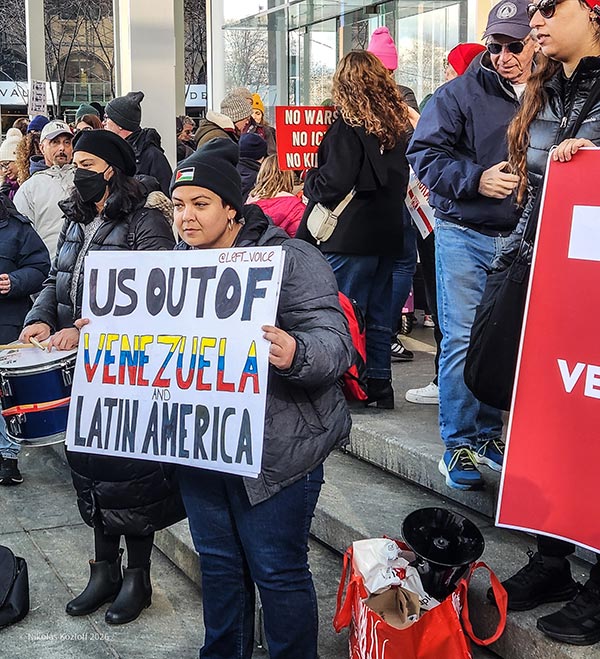
Moreover, even though large majorities of Democrats and Republicans disapproved of long-term involvement in Venezuela, ‘America First’ folk were “thrilled” by the operation. In fact, a whopping 80 percent of Trump voters said they supported Maduro’s capture, and 78 percent were unperturbed by the lack of congressional authorization. It’s unclear, however, whether the MAGA base would go along with a more open-ended occupation of Venezuela amid troop deployments.
All these contortions raise the question of ideological consistency. Was ‘America First’ simply a rhetorical conceit from the outset? Observers argue that MAGA was never entirely isolationist, since the president’s supporters backed a strike on Iran over the summer. Others declare that ‘America First’ isn’t defined by strict isolationism, but rather Washington asserting geographical hegemony within its own backyard. Republican House Representative from Ohio Jim Jordan, formerly an isolationist, now claims that Trump’s military adventurism in the Western Hemisphere is justified, since this is considered America’s traditional sphere of influence.
Rubio, a political chameleon, has managed to straddle fickle impulses within the MAGA coalition. A politician who was “more at home in the Republican Party of 2003,” Rubio later made globalization the centerpiece of his presidential campaign in 2016. Then, however, Rubio “evolved” by slamming free trade. In an abrupt U-turn, the Florida politician argued that the neo-liberal consensus ran counter to conservatism. Channeling angry and anti-elitist Trump voters, he wrote “capitalism must be cared for by capitalists who prioritize the well-being of their workers, the strength of their communities, and the health of their nation. Capitalism must be cared for by workers who understand their obligation to work and to contribute responsibly to our nation.”
How then should we define Rubio’s political identity at this point? The Secretary of State’s “true colors are a source of intrigue in Washington,” with the politician’s evolution prompting some to wonder whether “the former neoconservative hawk, a soundbite machine once mocked by Trump as ‘Macro Robotco,’” has now become “a reborn member of the Maga faithful…is he the apprentice, the moderator or the old-school Republican sleeper?”
To his detractors, Rubio is “the neocon who never really changed.” Perhaps, the former Florida Senator is “still more hawkish than most others in Trump’s network,” and “not pure MAGA when it comes to foreign policy.” Right wing observers believe the Secretary of State “has a view of the United States as being very active in the world, but he works for Donald Trump and so he is…pulling punches on many issues where he would prefer to be more forward-leaning, because he has to do what his boss tells him.”
Others, however, think Rubio “had a genuine change of heart” after being trounced by Trump in the 2016 election and has now chosen to embrace a “pragmatist” or merely “transactional” foreign policy that’s in line with Trump and Vance. Whatever the case, Rubio is a political survivor and has “quickly learnt that when it comes to winning an argument…proximity is key.” The Secretary of State “has inserted himself into Trump’s inner orbit with an almost anthropological care, learning when to speak, when to nod and when to simply stay in the room.”
Even as Rubio’s profile has risen, other figures within the administration have been sidelined. Take Tulsi Gabbard, a former Democrat tapped by Trump to become Director of National Intelligence (DNI). It was unlikely there could ever be an enduring “rightist-leftist anti-Deep State” convergence on foreign policy within Trump World, and the president’s Venezuela gambit has isolated Gabbard, with the DNI “intentionally excluded” from advance military planning. While still serving in Congress in 2019, Gabbard came out against U.S. interventionism in Venezuela, and even more recently lambasted “warmongers.” The acrimony got to the point that White House aides mocked Gabbard’s title as standing for “Do Not Invite.”
Gabbard, a former Bernie Sanders supporter backed by the isolationist Bannon, ran for president in 2020 on the Democratic ticket. Her “populist-nationalist” campaign fused “progressive policy stances with the kind of patriotic displays sometimes more associated with Republican campaigns.” Gabbard later abandoned her own party, which she labeled “an elitist cabal of woke warmongers.” When she was subsequently appointed as Trump’s DNI, the move “was seen as an injection of ideological diversity” and an expression of “heterodox views.”
However, Gabbard is now considered an outsider within an administration coalescing around hawkish elements. Indeed, even before she was excluded from planning on the Venezuela raid, Gabbard was absent from the Situation Room when Trump authorized airstrikes on Iran. The president has become so displeased with Gabbard that he has mused about nixing her office altogether or folding the DNI portfolio into the CIA or other agencies.
Perhaps, MAGA was always just a cynical game: as history has shown, authoritarians may initially depict themselves as anti-war, only to later morph into ultra-militaristic figures. “MAGAdom has never really been defined by a great concern for ideological consistency,” observers note. “It very much takes its cues from the leading figures… And of course, right now, Trump is signaling very heavily that Venezuelan intervention is what’s good for America.” Not mincing words, the president has stated that ‘America First’ is whatever he wants it to be. While the isolationist wing of MAGA is still a “loud minority,” other observers say that “at the end of day, what’s important to MAGA is winning. It’s reinforcing the United States as a bada– force for good.”
Within this milieu lacking any ideological coherence, a wide array of people pursuing separate agendas frequently swarm Trump on the golf course, ranging from foreign policy hawks to isolationists. For the moment, consummate operator Rubio, who “showed early on an aptitude for sensing which way the wind was blowing,” has managed to wield influence. Indeed, the Secretary of State “has survived by adapting, by absorbing Trump’s blows in 2016 and learning how to navigate the movement that replaced the party he once hoped to lead.”
But if Rubio runs for president in 2028, what type of foreign policy is he likely to pursue? Perhaps, the politician will return to more traditional Republican roots or alternatively become an isolationist. Ultimately, however, these distinctions may no longer matter. Judging from the reaction to Trump’s raid on Venezuela, most within the MAGA movement don’t hold to a core set of beliefs and, therefore, U.S. foreign policy need not adhere to any moral or political guidelines whatsoever.
Leave a comment