
Glaciers, Climate Change and Darwin’s Legacy in Chile
During global ice ages glaciers contributed to the rise of complex life, yet now could these imposing and towering structures contribute to our own undoing? It’s a question which might have intrigued Charles Darwin, who visited Chile at various points between 1832-1835 during his epic voyage of discovery aboard HMS Beagle. Though the naturalist focused on wildlife when formulating his theory of evolution, Darwin was also struck by the rugged landscape in Chile, and encountered widespread evidence of geological uplift over almost endless time, which allowed for natural selection to occur. In the wider scheme of things, Darwin’s geological observations whilst in Chile may have been under-estimated, since they influenced the scientist’s later thinking.
Last year, I retraced the naturalist’s travels in Chile in the context of growing climate change. In Santiago, I visited the Geological Museum, where I was impressed with samples of ancient ammonite fossils, the likes of which Darwin came across during his travels. After taking in the museum’s holdings, I sat down with Hans Kauffmann, a geo-chemist heading up government laboratories at the National Service of Geology and Mining (also known by the Spanish acronym SERNAGEOMIN). Darwin’s descriptions of natural terrain were important, he explained, since they laid the groundwork for future scientists visiting Chile. Moreover, Darwin didn’t simply formulate theories but rather came up with ideas based on direct observation and collection of field data.

-In Voyage of the Beagle, Darwin marveled at landscape in Tierra del Fuego and was impressed by the “beryl-like blue” of glaciers set against the “lurid sky.” In addition, he was struck by masses of ice falling from cliffs, with crashes reverberating “like the broadside of a man-of-war through the lonely channels.” At one point, the scientist described a harrowing scene with ice tumbling down and endangering the crew. There was a “roaring noise,” as a wave crept towards them, and Darwin worried about “being dashed to pieces,” though fortunately no one was seriously injured.
At other moments, the scientist mused on the long passage of geological time, writing that boulders lying near tall mountains had undoubtedly been pushed there by glaciers themselves. Though Darwin’s Chilean explorations are overlooked, his geological observations made an emotional impact on the young naturalist and helped inform the ultimate time-frame for evolution. Indeed, during his sojourns in Chile, Darwin gained insights into the actual ancient age of the world, which had a direct bearing on geological debates at the time.
If Darwin was aware of the true extent and importance of glaciers — bodies of slow-moving ice located on land which can range in age from several hundred to several thousand years old — he would have been amazed. We now know that as glaciers spread across the globe, they carved deep into the crust, thereby releasing key minerals from below. Later, after minerals were flushed out into ocean, they altered the sea’s chemistry, which in turn encouraged conditions making complex life possible. Indeed, it might be said that glaciers paved the way for multi-cellular organisms which subsequently gave rise to animals.
Along Chile’s Patagonia coast, deep fjords were created by the Pacific flooding into valleys originally carved out by glaciers. The coastline is home to complex marine ecosystems, including corals and anemones, and Patagonian fjords now host migrating blue whales. To the south in Tierra del Fuego lies Cordillera Darwin, a mountain range containing several glaciers. During the last Ice Age, the area was covered by an ice field. Then, some 20,000 years ago, the area experienced ice retreat, which continued for another several thousand years. More recently, however, during the so-called “Little Ice Age” from the fourteenth to mid-nineteenth century, glaciers are thought to have advanced in the Darwin Range. Then, in yet another reversal following the Little Ice Age, most Chilean Patagonian glaciers started losing mass at an accelerated rate.
Indeed, the same glaciers which helped give rise to life are now in steadfast retreat in the lands Darwin explored, and melting is proceeding much faster than during the end of the last Ice Age. That is concerning, since eighty percent of South America’s glaciers are to be found in Chile, and with 1,800 glaciers in total, the country has one of the most abundant reserves of freshwater on earth. Now, by contrast, scientists report recent surface melting of glaciers within the Darwin Range, and discharge of freshwater associated with such melting stands to exert immense impacts on coastal ecosystems.
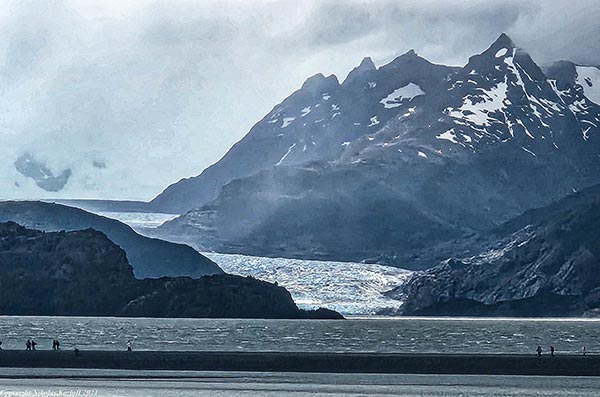
In Torres del Paine National Park, home to wildlife such as guanaco as well as a variety of bird species including chimango caracara (not to be confused with striated caracara, which I previously encountered in the Falkland Islands) and Darwin’s rhea, I glimpsed a glacier in the distance. Later, I bumped into members of a government fire brigade, who remarked that climate change had resulted in melting of glaciers while causing landslides. They also expressed concern that warming had negatively impacted pumas, which feed on guanaco, as well as the endangered Chilean huemul or South Andean deer, which appears on Chile’s coat of arms.
Carlos Cárdenas is a research scientist specializing in remote sensing and radio-glaciology at University of Magallanes, located in Punta Arenas. Chile’s southern zone, which includes Magallanes as well as the Aysén region, contains more than fifteen thousand ice formations. Speaking to me on campus within an unusual igloo-like building, Cárdenas leaves no doubt that glaciers are retreating due to climate change — though micro-climates may allow for specific, local conditions. Within Chile as a whole, the vast majority of glaciers are experiencing such retreat.
Cárdenas was concerned about the effects of glacial melting on local wildlife habitat. Punta Arenas had been protected by fjords, he added, though the city would certainly be impacted by melting as well as sea level rise. Indeed, melting of Patagonian glaciers has contributed to overall global sea level rise in recent decades. Furthermore, melting has also raised concerns about the future of Chile’s water supply. In Santiago, I met with Felipe and Constanza Espinosa of the Chilean Glacier Foundation. Felipe, management and operations director for the group, was worried about the nation’s capital, which relies on glaciers for a large portion of its water supply.
Reflecting on my experiences at Torres del Paine, I asked about landslides. This was concerning, remarked Constanza, Felipe’s sister and the foundation’s director of communications and outreach, since glacier collapse could affect nearby settlements. She drew my attention to recent trends at Exploradores Glacier, which had to be closed for safety reasons in late 2023. Located in the Aysén region, Exploradores had become unstable amid melting with a huge chunk of ice falling off the glacier.
Closure of the glacier came as a shock to local tourist operators, says Felipe. Perhaps, he added, hiking won’t be possible but visitors could still pursue other types of activities. Nearby, for example, lies San Rafael Lagoon National Park, a UNESCO Biosphere Reserve where tourists can hop on a boat while appreciating local wildlife including the South American gray fox, Chilean dolphins and marine otters.
Back at Santiago’s Museum of Geology, Kauffmann reflected on Darwin’s observations pertaining to uplift, ancient fossils and strata dating from distinct geological periods. Now, however, glacier melt could give rise to accelerated geological changes. In Patagonia, glacial retreat is leading to uplift in a process known as “glacial adjustment.” Normally, such uplift as noted by Darwin occurs very gradually, with only inches rising over thousands of years. By contrast, land is currently rising at a rate of 1.6 inches per year. Meanwhile, climate change is exerting pressure on glaciers, which cannot hold up rock faces. When ice breaks off mountainsides, it can lead to landslides and fall into the ocean. This in turn leads to seismic waves distinct from earthquakes, and tsunamis.
Research on glaciers has revealed that ultimately, land, oceans, atmosphere and climate are all inextricably linked. Ice-colored surfaces fulfill a vital role by reflecting excess heat into space, but if such surfaces are reduced through melting, then temperatures increase by an even greater margin. Glaciers, therefore, are vital in keeping the earth’s climate at moderate levels. Yet another conundrum which hasn’t received much scrutiny is the release of methane, a potent greenhouse gas, from glaciers. In Chile’s Northern Patagonia Icefield, scientists have detected methane from glacial meltwater, which “raises questions about the broader impacts of glacier emissions on regional and global climate change.”
Far from being devoid of life, glaciers host tiny organisms. In fact, deep within ice, cryoconite granules have been called “frozen rainforests.” Dark-colored cryoconite is composed of minerals and microbes dominated by cyanobacteria. Each granule is a self-contained ecosystem, hosting fungi, viruses and tiny animals such as tardigrades and worms. Small holes along the glacier surface filled with meltwater, called cryoconite holes, are “hotspots” for biodiversity and can be found within glaciers including Exploradores. Patagonian glaciers furthermore contain cyanobacteria, which may suggest the existence of microorganisms adapted to extreme meltwater conditions.
Though Darwin was taken aback by the dramatic outward spectacle of glaciers, he was unaware of all the inner workings within ice formations. Scientists argue glaciers should actually be considered biomes in their own right, since they contain “extremophile” organisms. Commenting on such tiny creatures, environmentalist Constanza Espinosa drew my attention to Andiperla winklii, also known as the Patagonian dragon stonefly. Unlike other larger animals such as whales, which may migrate within proximity of glaciers on a seasonal basis, the Patagonian dragon lives within the ice itself. Therefore, she adds, if we lose glaciers, “that creature is also going to become extinct.”
Leave a comment