
Airlifting Darwin’s Wildlife Legacy To Safety
Recently, London’s Heathrow airport welcomed some unlikely visitors: dozens of small frogs named after Charles Darwin. The amphibians, which are under threat from the deadly chytrid fungus, which causes an infectious disease called chytridiomycosis, had endured an epically long journey from South America. Transported from Chile’s Tantauco Park, located in the south of Chiloé Island, the frogs then took a six-hour boat ride to the mainland, followed by a 15-hour drive to Santiago, and at long last an exhausting 14-hour plane ride to the UK. During their trip, frogs were kept in custom-made climate-controlled boxes. The creatures arrived safely at London Zoo, where caretakers hope to save the species from extinction and, in time, reintroduce Darwin’s frog to Chile after bringing chytrid under control.
What would Darwin make of this curious spectacle, and the plight of his namesake amphibian? During his travels in South America, the scientist collected frogs and toads. Though Darwin wrote prolifically about reptiles and birds, his references to amphibians were less frequent. Nevertheless, Darwin’s observations pertaining to amphibians may have contributed to his subsequent ideas on evolution.
Currently, Darwin’s frog is under threat not only due to fungus, but also volcanic eruptions and climate change. Though Darwin wouldn’t be surprised by the idea that wildlife adapts and evolves in tandem with climate and local environmental conditions, the naturalist would undoubtedly be taken aback by the pace of global warming, and its particularly severe effects on amphibians.
Darwin’s frog is dependent on high humidity and native forest habitat comprised of age-old trees. Such high humidity allows the frog to lay its eggs in moss and leaf litter. However, native forests have experienced lower rainfall due to climate change, which in turn has dried out frog habitat. Dryer conditions lead to a reduction in plant and invertebrate species, which make up the frog’s main sources of food. Eucalyptus plantations, which have been replacing native forests and are known to burn rapidly, pose an additional obstacle to Darwin’s frog.
Last year during summer I retraced Darwin’s voyage in Chile to gauge the naturalist’s legacy in light of climate change. In the southern city of Punta Arenas, I caught up with Juan Francisco Pizarro, a government biologist. While there are some species which may withstand climate change more easily, such as the hardy guanaco, amphibians like Darwin’s frog are likely more sensitive and vulnerable, Pizarro noted.
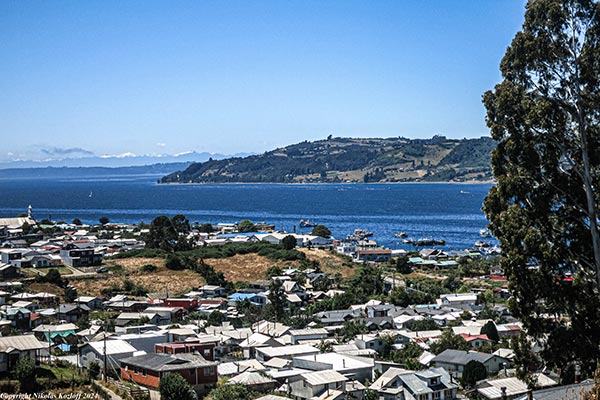
Following this sobering exchange, I flew one hour north to Puerto Montt, located near the Chiloé archipelago. It was here, on the island of Lemuy in 1834, that a young British naturalist discovered tiny Darwin’s frog, or Rhinoderma darwinii (to be precise, the scientist actually discovered Southern Darwin’s Frog, which should be distinguished from Rhinoderma rufum, also known as Chile Darwin’s frog, Northern Darwin’s Frog or Cowboy Toad, an amphibian subsequently classified as belonging to a different genus).
Curiously shaped like a leaf and sporting a pointed nose, Southern Darwin’s Frog is an expert at camouflage. Believing the frog is a dead leaf, snakes and predators may overlook the frog entirely. Moreover, the frog’s green and dark-spotted skin makes it blend into the forest floor. At first glance, perhaps Darwin may have wondered if the creature had consumed too many mosquitoes, since the frog appears puffy like a balloon. The frog’s outlandish appearance, however, can be explained by the fact that male frogs incubate offspring in their vocal sacs. Uniquely amongst amphibians, male Darwin’s frogs give birth to their young through an opening located under the father’s tongue, a process known as neomelia. Currently, Southern Darwin’s Frog is the last remaining frog which reproduces in this manner.
Despite its ingenious camouflage, the creature has been defenseless against other threats such as chytrid fungus, which interferes with the frog’s ability to breathe through its skin. This in turn results in the death of the animal within a few weeks. It seems humanity itself may be to blame: in the 1970s, the African clawed frog, an animal associated with chytridiomycosis, was introduced to Chile. However, the disease may also be easily spread through human activity.
As a result of exposure to fungal disease, numbers of Southern Darwin’s Frog have plummeted dramatically, and experts are now concerned about a veritable “amphibian pandemic.” Researchers hope the animal does not suffer the same fate as its northern cousin, which has not been spotted in the wild since 1980 and may be extinct. Northern Darwin’s Frog, which was also mouth-brooding, suffered from habitat loss. However, researchers believe chytridiomycosis may have dealt the critical blow. Chytrid, in fact, has led to the demise of at least ninety amphibian species, and Darwin’s frogs are particularly susceptible to the disease.
The forests of Tantuaco Park were considered a sanctuary for Southern Darwin’s Frog and the amphibian’s largest population center. However, frog numbers recently plummeted by ninety percent due to chytrid, which has led scientists to label Southern Darwin’s Frog as endangered. So scarce has the creature become that some residents may not even be aware of the frog’s existence. Such truths were revealed to me after I embarked on a trip from Puerto Montt to Chiloé. After my bus got off the ferry and we resumed our journey to Chiloé island, I turned to my tour guide, who remarked she had never seen the amphibian.
After touring Chiloé, I headed to nearby lush Vicente Pérez Rosales National Park, where scientists recently discovered another colony of Southern Darwin’s Frog. For years, park rangers had overlooked the frog and its discovery here was unexpected. Protecting the frog is a high priority, since the creature is considered a “flagship species” inhabiting endangered temperate forest. What is more, the amphibian serves as prey for other species such as birds and snakes — provided the latter can see through the amphibian’s shrewd camouflage strategy.

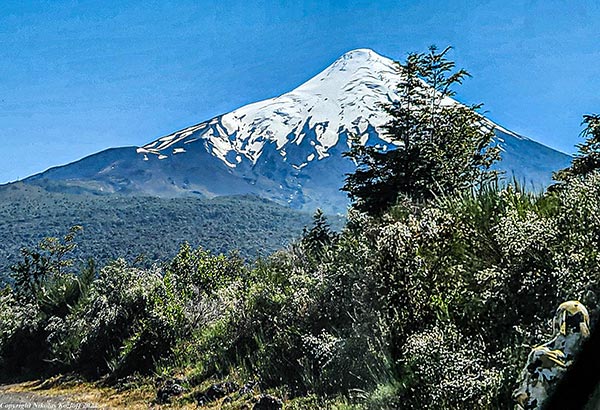
Walking through the forest, I marveled at the site of sinuous Arrayan trees. However, I also wondered whether the throngs of tourists were sustainable, and if authorities could protect local wildlife, including populations of Southern Darwin’s Frog. From the park, I traveled up to the base of Osorno volcano. In 1835, the volcano erupted and startled a young Darwin who observed the event from nearby Chiloé. In more recent times, scientists have grown concerned about the impact which volcanic eruptions and ash might have on Southern Darwin’s Frog within the area.

Later, during a long, grueling and suffocatingly hot bus ride from Puerto Montt to Concepción, I observed endless tree plantations along the side of the highway. Pine and eucalyptus plantations, which yield paper and wood, have also turned Chile into one of the world’s largest producers of cellulose, much to the detriment of Southern Darwin’s Frog. Temperate forests of south and central Chile have almost completely disappeared due to the rise of such plantations.
I’ve come to the end of my trip, and in Santiago I reflect on Darwin’s legacy. For 365 million years amphibians have inhabited the earth, and yet, up until recently, science failed to grasp their singular importance. Indeed, prior to Darwin and evolutionary theory, amphibians and reptiles were placed together in a single class. Though many may not appreciate amphibians, they are very important to humanity since the creatures consume insects and thereby maintain ecological balance. Without amphibians, pests would be much more abundant, which in turn would impact agriculture and result in more mosquito-borne diseases.
In the midst of a heatwave, I sat down with Bárbara Saavedra, director of Chile’s Wildlife Conservation Society. The plight of Southern Darwin’s Frog, she said, must be seen within a wider environmental context, since amphibians suffer from the effects of climate change and the spread of fungal diseases all over the world. Indeed, more than forty percent of amphibians are threatened by extinction due to spread of such diseases, amongst other causes.
If Southern Darwin’s Frog meets its demise, this would represent a crushing blow since amphibian neomelia, which took thousands of years to evolve, will be lost forever. That means there’s a lot riding on conservation efforts at London Zoo, where Southern Darwin’s Frogs are being kept in a bio-secure room simulating the amphibians’ native habitat, including cool temperatures, rainfall, lighting and foliage.
Fortunately, the tiny newcomers have already given birth to dozens of even tinier froglets, which researchers are hailing as a “landmark moment.” By breeding frogs abroad, researchers may learn more about potential treatments for chytrid, which in turn might lead to the reintroduction of Southern Darwin’s Frog to Tantauco Park. Hopefully, this emblematic species which once so fascinated the father of evolution will one day thrive again in ancient native forests.
Leave a comment